

The Future of Work of Public Transport
September - November 2025
Group Project · Master Level · Industrial Design Engineering
Course: Create the Future
This project explores the future of work in public transport by 2050 using systems thinking, futures thinking, and forecasting methods. By analysing trends and building long-term scenarios, it develops a human-centred mobility system of AI-powered transport pods, in which technology supports workers and creates more inclusive, collaborative roles. The project also reflects on the plausibility, desirability, and impact of this future through a final visual report and presentation.
Vision & Problem Definition
Public transport is undergoing a major transition, driven by technological innovation and societal change. To better understand the context of this project, the current situation can be broken down as follows:
WHO: Public transport operators and their workforce in the Netherlands, including drivers, technicians, control staff, and station personnel.
WHAT: Their roles are changing due to automation, labour shortages, and new technologies, requiring new skills while traditional tasks are disappearing.
WHEN: These changes are already happening and are expected to accelerate towards 2050.
WHY: Without intervention, this could lead to skill gaps, loss of experienced workers, and reduced trust in the system.
Understanding the System
To design for the future, we first needed to understand how the system works today and what is changing.
We analysed trends and weak signals to identify key drivers like automation, digitalisation, and workforce shifts. The STEEPV framework helped us look beyond technology and understand the wider context, including social values and policies.
Through stakeholder mapping and power–interest analysis, we explored who is involved and how they influence the system. This showed that while some actors hold more power, the everyday experience is shaped by workers and passengers.
From this, we identified key factors shaping the future and shifted our focus to how work within public transport is evolving.


Uncertainties & Futures
To explore the future, we first needed to understand which factors matter most and which are hardest to predict.
We used an uncertainty–importance matrix to map different variables. This helped us identify the factors that are both highly impactful and uncertain, as these will shape the future the most.
From this, we defined our key driving factors: automation, workforce adaptability, public trust, and energy costs. These drivers form the foundation for exploring different future directions. We then created a strategic space, mapping how these drivers could evolve in relation to each other.
Based on this space, we developed three scenarios:
-
A green and inclusive future focused on collaboration and fairness
-
A fragmented system driven by efficiency but marked by inequity
-
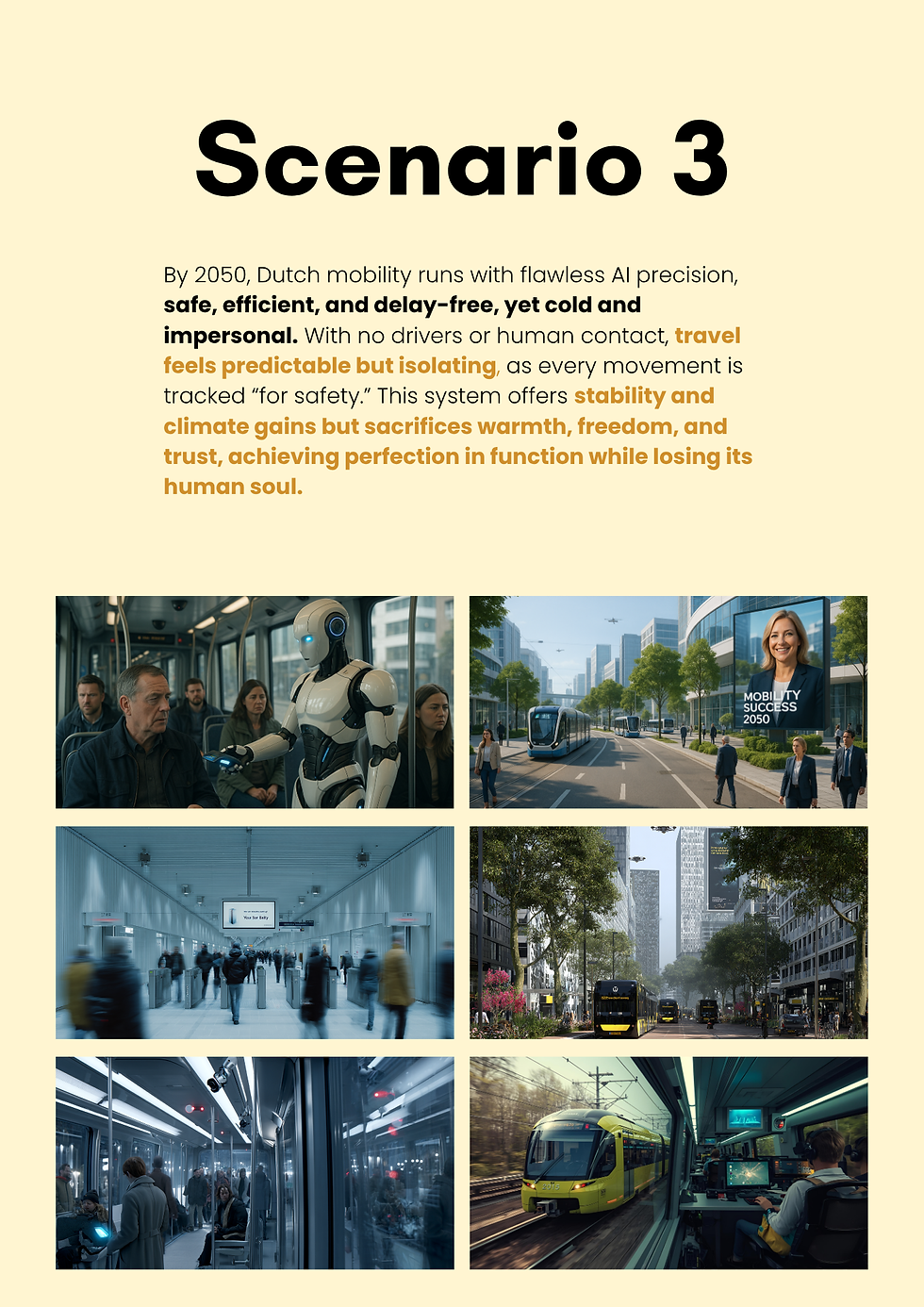
A fully automated system that is efficient but lacks human connection


Green & Inclusive Transition
By 2050, the Netherlands will exemplify a transport system that is sustainable, fair, and people-centred. Citizens enjoy clean, reliable, and affordable mobility, with cities calmer and greener, and rural areas well connected. Collaboration between government, workers, and communities ensures innovation creates better jobs, automation enhances human capability, and policies balance affordability, inclusivity, and social well-being.

Future System Design
Based on the chosen scenario, we designed a future public transport system built around a network of AI-powered transport pods. These pods operate as part of a connected system rather than fixed lines, allowing movement to be more flexible and demand-driven.
The system works on two levels: main routes, which provide fast and reliable connections between key hubs, and local routes, where pods adapt in real time to passenger demand. AI continuously manages routing, scheduling, and vehicle distribution, improving efficiency and reducing waiting times. Pods are modular and vary in size and function, allowing them to respond to different needs, such as individual travel, group transport, or accessibility support.


Human roles remain essential but are redefined. Nomadic drivers move across the network instead of being tied to one route, while passenger support staff assist users both physically and digitally. In addition, human oversight is maintained through system operators and governance roles, ensuring accountability in AI decision-making.
The system is designed to be transparent and understandable. Users can see how decisions are made, what routes are taken, and where human support is available. This helps build trust in an increasingly automated system.
User Journey
The user journey is designed to be seamless, adaptive, and reassuring. Passengers plan their trip through a digital interface that uses real-time data to suggest efficient routes, after which an AI-powered pod is assigned and dynamically adjusts its path based on demand. Throughout the journey, human presence remains visible through support staff at key touchpoints and system operators working in the background. Inside the pod, clear information and a calm, accessible environment help users understand and feel comfortable within the system, creating a travel experience that balances automation with human connection.

Personal Contributions
I took a leading role throughout the project, guiding its overall direction from research to final concept. I was actively involved across all phases, contributing to the development of insights, structure, and design decisions.
The development of scenarios and detailed system design was carried out collaboratively as a team, while visual renders were generated using AI tools.
I also led the redesign phase using the Product Impact Tool, refining the concept to strengthen trust, transparency, and the role of human interaction within the system.